novinski članak / 05.02.1977.
CONTINUITY OF ARTISTIC VISION
Transcript and record text
DOWNLOAD DOCUMENT
SUMMARY
Journalist and publicist Veljko Vučetić, writing in the “Creators and Works” column of Split’s Slobodna Dalmacija, examines Vasko Lipovac’s twelve years of artistic work in Split and the continuity of his artistic vision. The author highlights the enduring influence of the landscape and heritage of Lipovac’s native Kotor, his successful work in the applied arts, and the systematic reduction of his expression toward clarity of line and subtle tonalities. He pays special attention to the emergence of sculpture in Lipovac’s oeuvre, citing observations by sculptor Kosta Angeli Radovani on the artist’s command of space free from fashionable conformism.
INTEGRAL TEXT
CREATORS AND WORKS
Continuity of Artistic Vision
Source: Slobodna Dalmacija, Split, February 5, 1977
Author: Veljko Vučetić
Original Language: Croatian
The painter Vasko Lipovac, a native of Kotor, has been living and working in Split for twelve years. Intoxicated by the fantastic landscape of Kotor, Lipovac did not draw a boundary between his work and that landscape; rather, through the subtlest threads of his inspiration, he has attempted and continues to attempt to create a continuity of visual vision such as is born and emerges on this soil of ours from the earliest dates and monuments of our artistic heritage.
By: Veljko Vučetić
Lipovac has worked considerably in so-called applied art for hotels and various other public venues of visual culture, and was compelled to create works that would signify not only the symbolism of our spiritual landscape, but also a modern articulation of the visual arts. I believe he succeeds admirably in this, for it is precisely across diverse materials that he has managed to demonstrate his talent. And most importantly: various materials did not present an obstacle to his inspiration, but rather redoubled his curiosity to master and enrich them with his brush.
His first exhibitions were closely tied to the ambiance of Kotor, and there the symbolism of the landscape remained evident as a guidepost for his artistic ideas. Clearly, that was a search for his own path. For indeed subsequent visions demonstrate that from that temporal patina, only visual signs remained that link the new artistic concept.
That idea of Lipovac’s was in fact a reduction, an absolute reduction of material to the purity of lines. His most recent works speak eloquently of this clarity of vision, where tender colors have soared alongside very sparse drawing, announcing that Lipovac is on the path toward total liberation from tradition as it appeared in this region of ours.
It is fascinating in general to observe this artistic transformation, for an appropriate justifying term could be found for each phase of this growth and emergence.
Many art critics have wondered how sculpture appeared in the visual phantasmagoria of Vasko Lipovac. And he calmly replies that mastering diverse spaces and materials propelled his vision beyond the easel as well, drawing him close even to sculpture, into which he sought to imprint that same world of his own artistic naivety.
Kosta Angeli Radovani wrote about this problem in Lipovac’s work as follows: “His playfulness with alternatives of spatial imagination remains, nonetheless, a human drama. Shifting figures from cube to cube, and in general his sober and cautious taking possession of relationships, does not conceal the question of what purpose guides it, which is neither frivolous nor aimed at amusement. Nor does curiosity about mutual contacts of matter—that incidental parallelism with so many contemporary exercises—determine anything.
His sculpture is clear volume, thus in conflict with the intruder of mobilized esotericism; it is non-conformist. Leaning on folk anecdotalism, it excludes itself from the sphere of contemporary Alexandrianisms, and seeks no stronger word than a proverb.”
Vasko Lipovac continues to seek his artistic furrow. As though beginning afresh—such is the drama of every artistic inspiration. It is true that his sculpture surprised us and sometimes seemed shocking and bizarre, as a challenge facing human attention and the human eye. But such is the destiny of art: to balance between endurance and the impossible, between reality and actual life, between naivety and concrete vision that tolerates neither half-measures nor the ordinary, but rather absorbs all traces of time into a new creation, which in the examples of Vasko Lipovac’s painting we might call a continuity of visual vision, and a reduction of the optical scale to the sight of the finest subtle tones.
Transcription note: this text was transcribed from the original newspaper clipping published in Slobodna Dalmacija on February 5, 1977. The transcription faithfully preserves the original; the original scan is available for download in PDF format.
Citation
Veljko Vučetić. „CONTINUITY OF ARTISTIC VISION”. Slobodna Dalmacija, Split, February 5, 1977. 05.02.1977.. Vasko Lipovac — Bibliography and digital archive. VL-BIB-1977-KONTINUITET-LIKOVNE-VIZIJE. https://arhiva.vaskolipovac.hr/en/bibliografija/1977-kontinuitet-likovne-vizije/
Related records
video, tv-show, interview 21.08.2026.
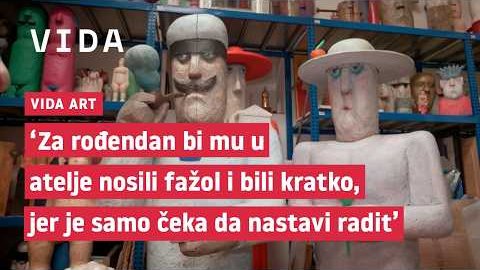
VIDA art - Vasko Lipovac: A World-Class Artist from Split
Video feature and reportage by journalist Branimir Zekić for VIDA art (VIDA TV, August 2026) dedicated to sculptor, painter, and printmaker Vasko Lipovac. The report explores Split’s relationship to the priceless legacy of the modern master, documents the family’s efforts to keep …
članak, esej, biografija 15.01.2026.
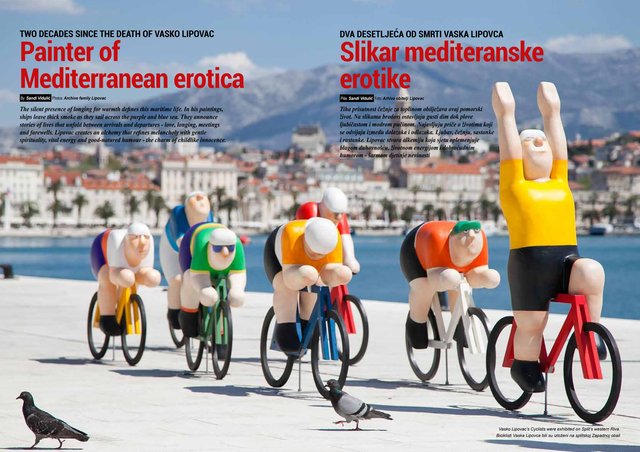
Painter of Mediterranean Erotica: Two Decades Since the Death of Vasko Lipovac
Comprehensive bilingual (Croatian/English) feature essay and retrospective survey by journalist and art historian Sandi Vidulić, published in the official luxury edition Visit Split by the Split Tourist Board (2026) commemorating two decades since the death of Vasko Lipovac …
video, short-film 02.02.2022.
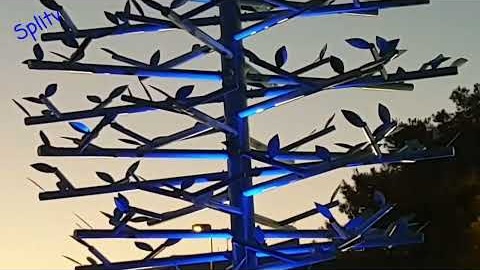
The Blue Tree: Vasko Lipovac in the Park by Dom Mladih in Split
Short video clip by the Split video portal Splitv capturing the presence of Vasko Lipovac’s monumental public sculpture “The Blue Tree” (Plavo stablo) in the park next to Dom Mladih and the HRT building in Split (Ulica slobode). The footage showcases the harmonious interplay …