newspaper article / 24.08.1977.
A World That Children Left Behind for a Moment
Transcript and record text
DOWNLOAD DOCUMENT
SUMMARY
Article and interview with Vasko Lipovac by Lada Đurović, published in the Titograd daily newspaper Pobjeda on August 24, 1977, under the title “Meeting with the Artist: A World That Children Left Behind for a Moment”. In the interview, Lipovac discusses the evolution of his artistic vision from early paintings of quiet, empty squares to the reduction of human figures into archetypal geometric forms (cylinder, cone, and sphere), the role of playfulness, cheerfulness, and subtle irony as a counterbalance to life’s drama, his enduring inspiration from the Bay of Kotor (Boka), and his recent decorative interventions in architectural interiors. The article is illustrated with a photograph of his sculpture Sailor with Boat in Hand (detail).
INTEGRAL TEXT
Meeting with the Artist: A World That Children Left Behind for a Moment
Author: Lada Đurović
Newspaper: Pobjeda, Titograd, Wednesday, August 24, 1977, p. 13, Kult section
Illustration: Photograph: Vasko Lipovac: Sailor with Boat in Hand (detail)
Pobjeda, August 24, 1977
MEETING WITH THE ARTIST
A WORLD THAT CHILDREN LEFT BEHIND FOR A MOMENT
Vasko Lipovac seeks and finds a modern expression in his oeuvre * The foundation of his world vision is play, and the inspiration is Boka
Over the last two decades, working quietly and devotedly according to his own artistic concept and building an authentic expression in sculpting his own vision of the world, Vasko Lipovac has developed into an original personality in our contemporary fine art creation.
His path in search of his own formula of life is consistent and direct, without sudden reversals. He enriches his initial idea while simultaneously purifying it, so that now, in the painter’s full life and artistic maturity, it is simple, poetic, and freed from anything superfluous. At the core of his art stands humanity, and throughout his creative journey, he searches for the metaphor of the human face. He finds it quite early in the doll-figure, whose shape he gradually reduces over time into three basic elements: the cylinder, the cone, and the sphere. Regardless of his evolutionary path and the various techniques he applies, he remains faithful to his primary inspiration — Boka.
— In the beginning of my work, I painted empty and silent squares, faces that silently leave the stage of life. The scenery of night walkers gave way to the figure as a contemporary medium of expression. The world of countless mournful captains, modest brides, and sailing vessels becomes universal; I brought past nostalgias closer to the present — explains painter Vasko Lipovac.
Telling a beautiful and humane tale about his native region, Lipovac imparts a universal human meaning to it, speaking fundamentally about the drama of human existence. Yet sorrow is not a defining characteristic of his art; it is only gently present alongside a touch of irony and humor, for his painting is bright and joyful.
Painting always the same picture and expressing his vision of the world, he neither rebels nor protests, but accepts it as it is, offering play in its place. The human figure contoured like a toy, a sailor holding a boat in his hand, a parasol over the head, a knight with a shield — all of this resembles a world that children left behind for a moment. However, it is a metaphor of our desires and our need for the joy of living — Vasko Lipovac added to complete the thought.
The coloring of Lipovac’s paintings is warm and cheerful, ranging from brown through all tones of blue, with a noticeable presence of vibrant colors.
Recently, he has done extensive decorative artistic interventions in architectural interiors. Such work, says the painter, gives him special satisfaction, because on a large architectural scale he can narrate part of his tale while reaching a wide audience. The decorative function is, naturally, primary, because the environment must be pleasant and beautiful.
Vasko Lipovac is not only thematically attached to Kotor, but also emotionally; each year he spends two to three months in his hometown, where he also maintains a gallery. He graduated from the Academy of Fine Arts in Zagreb, and from 1955 to 1959 was an associate in the Master Workshop of Krsto Hegedušić. Today he lives and works in Split.
A succession of exhibitions in prominent domestic and international galleries — for example in New York, Caracas, Rome, Zagreb, Belgrade, Dubrovnik, Titograd, Split, and other cities — as well as numerous awards and distinctions attest that he has found a true artistic expression in articulating his world.
Although the painter could not yet share a definitive date, we trust he will soon delight us with a solo exhibition in Kotor.
Lada Đurović
Note on transcript: The article was originally published in Cyrillic script in the daily newspaper “Pobjeda” (Titograd, August 24, 1977, p. 13). The original document is available for download in PDF format.
Citation
Lada Đurović. „A World That Children Left Behind for a Moment”. Pobjeda, Pobjeda, Titograd, August 24, 1977, p. 13. 24.08.1977.. Vasko Lipovac — Bibliography and digital archive. VL-BIB-1977-SVIJET-DJECA-OSTAVILA. https://arhiva.vaskolipovac.hr/en/bibliografija/1977-svijet-koji-su-djeca-na-cas-ostavila/
Related records
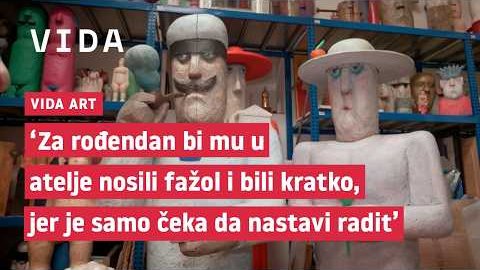
video, tv-show, interview 21.08.2026.
VIDA art - Vasko Lipovac: A World-Class Artist from Split
Video feature and reportage by journalist Branimir Zekić for VIDA art (VIDA TV, August 2026) dedicated to sculptor, painter, and printmaker Vasko Lipovac. The report explores Split’s relationship to the priceless legacy of the modern master, documents the family’s efforts to keep …
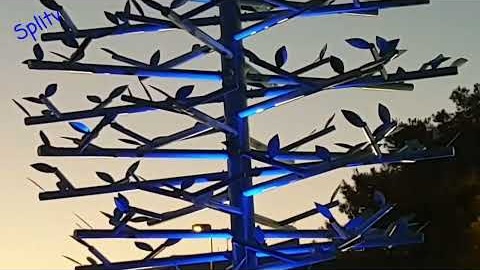
video, short-film 02.02.2022.
The Blue Tree: Vasko Lipovac in the Park by Dom Mladih in Split
Short video clip by the Split video portal Splitv capturing the presence of Vasko Lipovac’s monumental public sculpture “The Blue Tree” (Plavo stablo) in the park next to Dom Mladih and the HRT building in Split (Ulica slobode). The footage showcases the harmonious interplay …
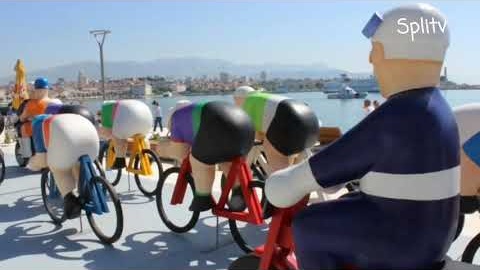
video, short-film 04.07.2021.
Cyclists by Vasko Lipovac (Splitv, In Memoriam 2006–2021)
Commemorative video feature by the Split video portal Splitv published on July 4, 2021, marking the 15th anniversary of Vasko Lipovac’s death (1931–2006). The video is dedicated to the celebrated and beloved sculpture cycle “Cyclists” (Biciklisti) installed along Split’s West …